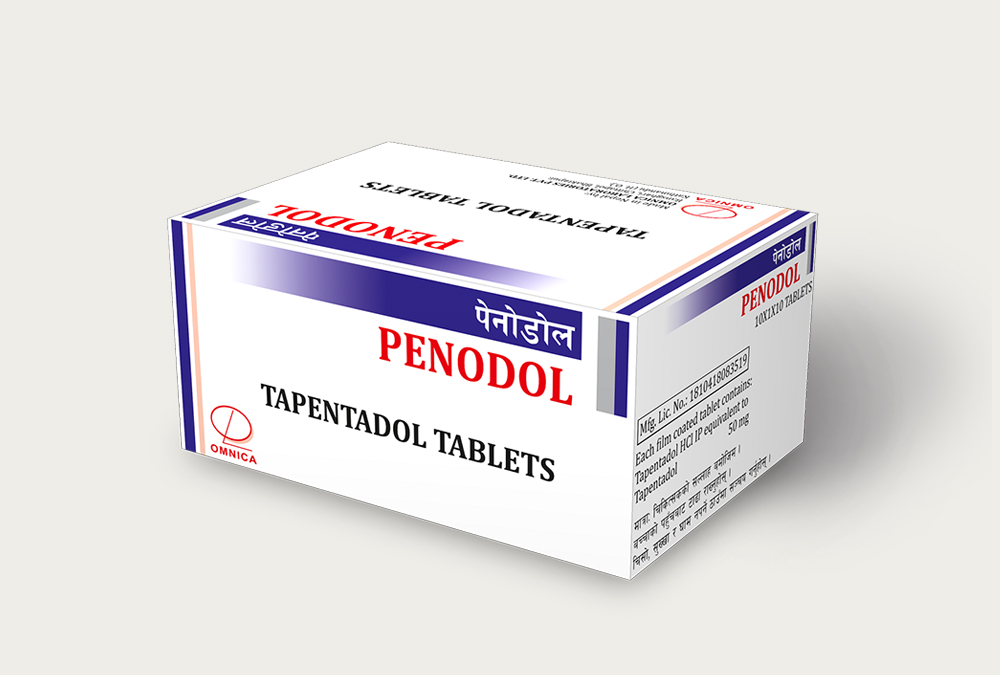
Brand Name: PENODOL
Generic Name: Tapentadol
Preparation: 50 mg Tablet
Pharmacological Category: Opioid
Mechanism of Action (Moa)
PENODOL (Tapentadol) is a centrally acting synthetic analgesic. PENODOL is believed to have two main mechanisms of action. PENODOL is a selective mu-opioid receptor agonist. It binds with mu-opioid receptors with an affinity greater than or equal to ten-fold affinity compared to delta- and kappa-opioid receptors. PENODOL also inhibits noradrenaline reuptake, thereby increasing noradrenaline levels and activating alphat-2 receptors to promote analgesia
Pharmacokinetics
Absorption: Rapid and completely
Peak Plasma Time: 1.25 hours
Protein Binding: 20%
Metabolism: Liver via glucuronidation
Distribution: Widely distributed throughout the body
Elimination Half-life: 4 hours
Excretion: Urine (99%)
Indications and Dosage
Moderate to severe acute pain:
The dosing regimen should be individualised according to the severity of pain being treated, the previous treatment experience and the ability to monitor the patient.
Patients should start treatment with single doses of 50 mg tapentadol as film-coated tablet administered every 4 to 6 hours. Higher starting doses may be necessary depending on the pain intensity and the patient’s previous history of analgesic requirements. On the first day of dosing, an additional dose may be taken as soon as one hour after the initial dose, if pain control is not achieved. The dose should then be titrated individually to a level that provides adequate analgesia and minimises undesirable effects under the close supervision of the prescribing physician.
Total daily doses greater than 700 mg tapentadol on the first day of treatment and maintenance daily doses greater than 600 mg tapentadol have not been studied and are therefore not recommended.
Dose modifications
Renal impairment
CrCl≥30 mL/min: Dosage adjustment not required
CrCl<30 mL/min: Not recommended
Hepatic impairment
Mild (Child-Pugh A): Dosage adjustment not required
Sever (Child-Pogh C): Not recommended
Moderate (Child-Pogh B): Not to exceed 50 mg every 8 hours
Elderly patients (persons aged 65 years and over): In general, a dose adaptation in elderly patients is not required. However, as elderly patients are more likely to have decreased renal and hepatic function, care should be taken in dose selection as recommended.
Paediatric Patients: The safety and efficacy in children and adolescents below 18 years of age has not yet been established. Therefore PENODOL is not recommended for use in this population.
Withdrawal symptoms could occur after abrupt discontinuation. When a patient no longer requires therapy, it may be advisable to taper the dose gradually to prevent symptoms of withdrawal.
Method of administration: The tablet should be taken with sufficient liquid. PENODOL can be taken with or without food
Side Effects
Very common: Dizziness, somnolence, headache, nausea, vomiting
Common: Decreased appetite, anxiety, confusional state, hallucination, sleep disorder, abnormal dreams, tremor, flushing, constipation, diarrhea, dyspepsia, dry mouth, pruritus, hyperhidrosis, rash, muscle spasms, asthenia, fatigue, feeling of body temperature change
Uncommon: Depressed mood, disorientation, agitation, nervousness, restlessness, euphoric mood, disturbance in attention, memory impairment, presyncope, sedation, ataxia, dysarthria, hypoaesthesia, paraesthesia, involuntary muscle contractions, visual disturbance, increased heart rate, palpitations, decreased blood pressure, respiratory depression, dyspnea, abnormal discomfort, urticarial, sensation of heaviness, urinary hesitation, pollakiuria, drug withdrawal syndrome, oedema, feeling abnormal or drunk or relaxation, irritability
Rare: Impaired gastric emptying, decreased heart rate, convulsion, depressed level of consciousness, incoordination, abnormal thinking, hypersensitivity
Contraindications
Hypersensitivity, significant respiratory depression, acute or severe bronchial asthma or hypercapnia, paralytic ileus, acute intoxication with alcohol, hypnotics, centrally acting analgesics, or psychotropic active substances
Warnings / Precautions
- Tolerance, physical and psychological dependence, and opioid use disorder (OUD) may develop upon repeated administration of opioids. Abuse or intentional misuse of opioids may result in overdose and/or death. The risk of developing OUD is increased in patients with a personal or a family history of substance use disorders (including alcohol use disorder, tobacco users), or in patients with a personal history of other mental health disorders (e.g. major depression, anxiety and personality disorders).
- Patients will require monitoring for signs of drug-seeking behaviour (e.g. too early requests for refills). This includes the review of concomitant opioids and psycho-active drugs (like benzodiazepines). For patients with signs and symptoms of OUD, consultation with an addiction specialist should be considered.
- If a decision is made to prescribe tapentadol concomitantly with sedating medicinal products, the reduction of dose of one or both agents should be considered and the duration of the concomitant treatment should be as short as possible.The patients should be followed closely for signs and symptoms of respiratory depression and sedation. In this respect, it is strongly recommended to inform patients and their caregivers to be aware of these symptoms.
- Tapentadol should be administered with caution to patients with impaired respiratory functions. Alternative non-mu-opioid receptor agonist analgesics should be considered and tapentadol should be employed only under careful medical supervision at the lowest effective dose in such patients. If respiratory depression occurs, it should be treated as any mu-opioid receptor agonist-induced respiratory depression.
- Tapentadol should not be used in patients who may be particularly susceptible to the intracranial effects of carbon dioxide retention such as those with evidence of increased intracranial pressure, impaired consciousness, or coma. Analgesics with mu-opioid receptor agonist activity may obscure the clinical course of patients with head injury. Tapentadol should be used with caution in patients with head injury and brain tumors.
- Tapentadol is not recommended in patients with a history of a seizure disorder or any condition that would put the patient at risk of seizures. In addition, tapentadol may increase the seizure risk in patients taking other medicinal products that lower the seizure threshold.
- Active substances with mu-opioid receptor agonist activity may cause spasm of the sphincter of Oddi. Tapentadol should be used with caution in patients with biliary tract disease, including acute pancreatitis.
- Opioids can cause sleep-related breathing disorders including central sleep apnea (CSA) and sleep-related hypoxemia. Opioid use increases the risk of CSA in a dose-dependent fashion. In patients who present with CSA, consider decreasing the total opioid dosage.
- On combined use with buprenorphine, higher dose requirements for full mu-receptor agonists have been reported and close monitoring of adverse events such as respiratory depression is required in such circumstances.
- Tapentadol may have major influence on the ability to drive and use machines, because it may adversely affect central nervous system functions. This has to be expected especially at the beginning of treatment, when any change of dosage occur as well as in connection with the use of alcohol or tranquilisers. Patients should be cautioned as to whether driving or use of machines is permitted.
Drug Interactions
- The concomitant use with sedating medicinal products such as benzodiazepines or other respiratory or CNS depressants (other opioids, antitussives or substitution treatments, barbiturates, antipsychotics, H1-antihistamines, alcohol) increases the risk of sedation, respiratory depression, coma and death.
- The concomitant use of opioids and gabapentinoids (gabapentin and pregabalin) increases the risk of opioid overdose, respiratory depression and death.
- Care should be taken when combining with mixed mu-opioid agonist/antagonists (like pentazocine, nalbuphine) or partial mu-opioid agonists (like buprenorphine).
- Can induce convulsions and increase the potential for selective serotonin reuptake inhibitors (SSRIs), serotonin norepinephrine reuptake inhibitors (SNRIs), tricyclic antidepressants, antipsychotics and other medicinal products that lower the seizure threshold to cause convulsions.
- The major elimination pathway for tapentadol is conjugation with glucuronic acid mediated via uridine diphosphate transferase (UGT) mainly UGT1A6, UGT1A9 and UGT2B7 isoforms. Thus, concomitant administration with strong inhibitors of these isoenzymes may lead to increased systemic exposure of tapentadol.
- For patients on tapentadol treatment, caution should be exercised if concomitant drug administration of strong enzyme inducing drugs (e.g. rifampicin, phenobarbital, St John’s Wort (hypericum perforatum)) starts or stops, since this may lead to decreased efficacy or risk for adverse effects, respectively
- Treatment should be avoided in patients who are receiving monoamine oxidase (MAO) inhibitors or who have taken them within the last 14 days due to potential additive effects on synaptic noradrenaline concentrations which may result in adverse cardiovascular events, such as hypertensive crisis.
Pregnancy Category: There is very limited amount of data from the use in pregnant women.
Presentation
PENODOL: 10X1X10’s