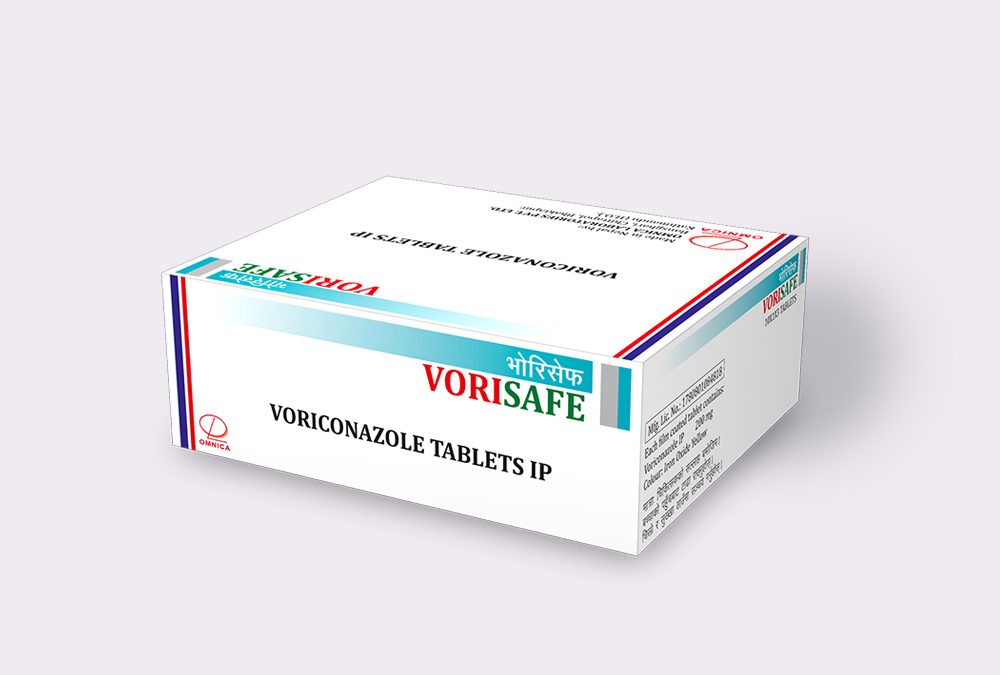
Brand Name: VORISAFE
Generic Name: Voriconazole
Preparation: 200 mg Tablet
Pharmacological Category: Antifungal
Mechanism of Action
VORISAFE (Voriconazole) is a broad spectrum triazole antifungal agent. VORISAFE inhibits fungal cytochrome P450-mediated 14 alpha-lanosterol demethylation, a vital step in cell membrane ergosterol synthesis in fungi. The accumulation of 14 alpha-methyl sterols correlates with the subsequent loss of ergosterol in the fungal cell membrane and may be responsible for the antifungal activity of VORISAFE. VORISAFE has been shown to be more selective for fungal cytochrome P-450 enzymes than for various mammalian cytochrome P-450 enzyme systems.
Pharmacokinetics
Absorption: Rapidly and almost completely
Bioavailability: 96%
Peak Plasma Concentration: 1 to 2 hours
Protein Binding: 58%
Metabolism: Hepatic cytochrome P450 isoenzymes CYP2C19, CYP2C9 and CYP3A4
Half-life: Dose dependent
Excretion: Urine
Indications and Dosage
- Invasive aspergillosis
- Candidaemia (in non-neutropenic patients)
- Fluconazole resistant serious invasive Candida infections
- Oesophageal candidiasis
- Serious fungal infections (caused by Scedosporium spp. and Fusarium spp.)
Dose
Loading dose for the first 24 hours
- Patients more than 40 kg: 400 mg every 12 hours
- Patients under 40 kg: 200 mg every 12 hours
Maintenance dose after first 24 hours
- Patients over 40 kg: 200 mg twice daily, increased to 300 mg twice daily if the response is inadequate
- Patients under 40 kg: 100 mg twice daily, increased to 15O mg twice daily if the response is inadequate
Administration: Tablets should be taken at least 1 hour before or after meal
Side Effects
VERY COMMON: Peripheral oedema, headache, visual impairment, respiratory distress, diarrhoea, vomiting, abdominal pain, nausea, liver function test abnormal, rash, pyrexia
COMMON: Sinusitis, agranulocytosis, pancytopenia, leukopenia, anaemia, hypoglycemia, hypokalaemia, hyponatraemia, depression, hallucination, anxiety, insomnia, agitation, confusional state, convulsion, syncope, hypertonia, paraesthesia, somnolence, dizziness, retinal haemorrhage, supraventricular arrhythmia, tachycardia, bradycardia, hypotension, phlebitis, acute respiratory syndrome, pulmonary oedema, cheilitis, dyspepsia, constipation, gingivitis, jaundice, cholestatic jaundice, hepatitis, exfoliative dermatitis, alopecia, maculopapular rash, pruritus, erythema, back pain, acute renal failure, haematuria, chest pain, face oedema, asthenia, chills, increased blood creatinine
UNCOMMON: Pseudomembranous colitis, bone marrow failure, lymphadenopathy, eosinophilia, hypersensitivity, adrenal insufficiency, hypothyroidism, brain oedema, encephalopathy, extrapyramidal disorder, peripheral neuropathy, ataxia, hypoaesthesia, dysguesia, optic nerve disorder, papilloedema, oculogyric crisis, diplopia, scleritis, blepharitis, hypoacusis, vertigo, tinnitus, ventricular fibrillation, ventricular extrasystoles, ventricular tachycardia, electrocardiogram QT prolonged, supraventricular tachycardia, thrombophlebitis, lymphangitis, peritonitis, pancreatitis, swollen tongue, duodenitis, gastroenteritis, glossitis, hepatic failure, hepatomegaly, cholecystitis, cholelithiasis, Stevens-Johnson syndrome, phototoxicity, purpura, urticaria, allergic dermatitis, popular rash, macular rash, eczema, arthritis, renal tubular necrosis, proteinuria, nephritis, increased blood urea and cholesterol
RARE: Disseminated intravascular coagulation, anaphylactoid reaction, hyperthyroidism, hepatic encephalopathy, Guillain-Barre syndrome, nystagmus, optic atrophy, corneal opacity, torsades de pointes, complete atrioventricular block, bundle branch block, nodal rhythm, toxic epidermal necrolysis, drug reaction with eosinophilia and systemic symptoms, angioedema, actinic keratosis, pseudoporphyria, erythema multiforme, psoriasis, drug eruption
FREQUENCY NOT KNOWN: Squamous cell carcinoma, cutaneous lupus erythematosus, ephelides, lentigo, periostitis
Contraindications
Hypersensitivity, coadministration with CYP3A4 substrates, terfenadine, astemizole, cisapride, pimozide, quinidine, ivabradine, rifampicin, carbamazepine, phenobarbital and St John’s wort, efavirenz, high-dose ritonavir, ergot alkaloids (ergotamine, dihydroergotamine), sirolimus, naloxegol, tolvaptan, lurasidone, venetoclax at initiation and during venetoclax dose titration phase
Warnings / Precautions
- Acute renal failure may occur with voriconazole and renal function should be monitored during treatment. Liver function should also be monitored before and during treatment with voriconazole. It should be used with caution in patients with hepatic impairment and doses may need to be adjusted.
- Visual disturbances may occur and patients affected should not drive or operate hazardous machinery. In addition, all patients, whether affected by visual disturbances or not, should not drive at night, and should have their visual function monitored if they are receiving voriconazole for more than 28 days.
- Voriconazole has been associated with QT interval prolongation and should therefore be given with caution to patients with potentially pro-arrhythmic conditions.
- To minimise the risk of phototoxicity, direct sun exposure should be avoided and suitable clothing and sunscreen should be worn.
- Treatment periods should be as short as possible, and long-term treatment (> 6 months) should be considered only where the benefits clearly outweigh the risks.
- Voriconazole has been shown to be teratogenic and embryotoxic in animal studies and its use is generally not recommended during pregnancy.
- Women of child-bearing potential are recommended to use effective contraception during treatment with voriconazole.
Interactions
- Use of drugs that either inhibit or induce cytochrome P450 isoenzymes CYP2C19, CYP2C9, and CYP3A4 may increase or decrease plasma concentrations of voriconazole respectively.
- Concentrations of other drugs that are metabolised by CYP2C19, CYP2C9, or CYP3A4 may be increased by voriconazole.
- Monitoring and possible dose reductions of some opioid analgesics (such as alfentanil, fentanyl, hydrocodone, methadone, oxycodone, and sufentanil) may be needed during concomitant use.
- Concentrations of oral anticoagulants may be affected and increased prothrombin time has occurred with warfarin; monitoring should therefore be carried out.
- Close monitoring of blood glucose is necessary if voriconazole is used with oral hypoglycaemics such as the sulfonylureas.
- Dose reductions may be needed for some statins, calcium channel blockers, NSAIDs, vinca alkaloids, and some benzodiazepines (such as alprazolam, midazolam, and triazolam) if their plasma concentrations are increased.
- Interactions may occur where both voriconazole and the other drugs such as phenytoin and rifabutin are affected. If it is essential to give either drug with voriconazole, an increase in the dose of voriconazole is recommended.
- With proton pump inhibitors, the plasma concentration of both drugs may be increased and a reduced dose of proton pump inhibitors is recommended.
- Voriconazole may inhibit metabolism of non-nucleoside reverse transcriptase inhibitors and they in turn may either inhibit the metabolism of voriconazole (e.g. delavirdine) or induce the metabolism of voriconazole (e.g. efavirenz and nevirapine); if co-administration of voriconazole and efavirenz cannot be avoided, an increase in the dose of voriconazole and a decrease in the dose of efavirenz is recommended.
- Voriconazole may inhibit metabolism of HIV-protease inhibitors (e.g. saquinavir, amprenavir, and nelfinavir) while they may in turn inhibit the metabolism of voriconazole.
- Low doses of ritonavir (100 mg twice daily) may decrease plasma concentrations of voriconazole; co-administration should be avoided where possible.
Pregnancy Category: D
Presentation
VORISAFE: 10x1x3