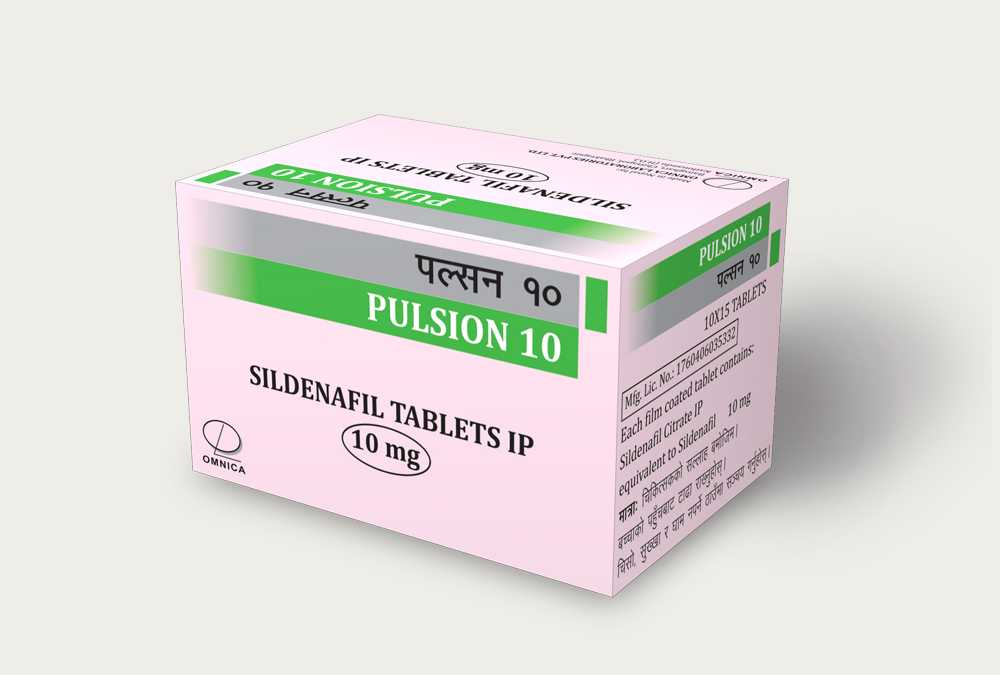
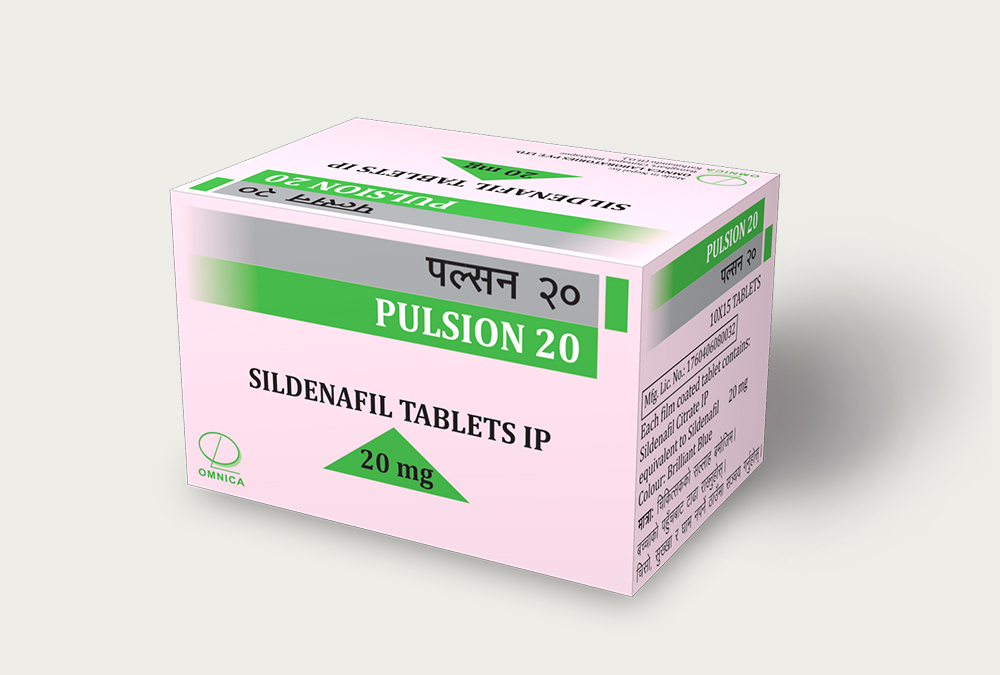
Brand Name: PULSION
Generic Name: Sildenafil Citrate equivalent to Sildenafil
Preparations: 10/20 mg Tablets
Pharmacological Category:
Mechanism of Action
PULSION (Sildenafil citrate) inhibits phosphodiesterase type 5 (PDE-5) in smooth muscle of pulmonary vasculature where PDE-5 is responsible for the degradation of cyclic guanosine monophosphate (cGMP). Therefore, PULSION increases cGMP concentration within pulmonary vascular smooth muscle cells resulting in relaxation. This leads to vasodilation of the pulmonary vascular bed and, to a lesser degree, vasodilation in the systemic circulation.
Pharmacokinetics
Absorption: Rapidly absorbed from gastrointestinal tract
Bioavailability: About 40%
Peak Plasma Concentrations: 30 to 120 minutes
Distribution: Widely distributed into tissues
Protein Binding: About 96%
Metabolism: Liver; active metabolite: N-desmethylsildenafil
Elimination Half-life: 4 hours (Both sildenafil and metabolite)
Excretion: Mainly faeces and to lesser extent urine (as metabolite)
Indications and Dosage
Pulmonary arterial hypertension:
Adult: 20 mg three times daily
Children weighing 20 kg or less: 10 mg three times daily
Children weighing over 20 kg: 20 mg three times daily.
Mild to moderate renal impairment: Dose adjustment is not needed. However, if not tolerated, dose is reduced to 20 mg twice daily.
Renal impairment: Dose adjustment is not required. However, if not tolerated, dose is reduced to 20 mg twice daily.
Side Effects
MOST COMMON: Headache, flushing, diarrhoea, and dyspepsia
COMMON: Visual disturbances such as blurred vision, photophobia, chromatopsia, cyanopsia, eye irritation, pain and redness of the eyes, dizziness, insomnia, anxiety, vertigo, epistaxis, nasal congestion, pyrexia, gastrointestinal disturbances such as diarrhoea and vomiting
OCCURRED: Priapism, dyspnoea, cough, rhinitis, sinusitis, bronchitis, cellulitis, cerebrovascular haemorrhage, and transient ischaemic attacks
OTHER: Skin rashes, erythema, alopecia, limb and/or back pain, myalgia, facial oedema, fluid retention, paraesthesia, and urinary-tract infection
REPORTED: Sudden decrease or loss of hearing, anaemia, leucopenia, gynaecomastia, urinary frequency or incontinence, hematuria, seizures, palpitations, syncope, hypertension, hypotension, and serious cardiovascular events including myocardial infarction, arrhythmias, tachycardia, unstable angina, and sudden cardiac death
RARELY REPORTED: Retinal haemorrhage, Non-arteritic anterior ischaemic optic neuropathy (NAION), hypersensitivity reactions
Contraindications
Severe hepatic impairment, bleeding disorders, active peptic ulceration, hypotension, hypertension, a recent history of stroke, myocardial infarction, or life-threatening arrhythmia, unstable angina, heart failure, or retinal disorders such as retinitis pigmentosa
Warnings/ Precautions
- Caution is required in patients with hepatic or severe renal impairment, and dosage reduction of sildenafil may be necessary.
- Care is also needed in patients with anatomical deformation of the penis or haematological disorders that may predispose them to priapism. In the event of prolonged erection (for more than 4 hours), patients should seek medical assistance, as penile tissue damage and permanent loss of potency can occur.
- Patients are also advised to stop taking sildenafil and seek medical advice in cases of sudden visual or hearing loss. Sildenafil should not be given to those with loss of vision in one eye caused by non-arteritic anterior ischaemic optic neuropathy (NAION), regardless of whether this was in connection with previous phosphodiesterase type-5 inhibitors or not.
- Patients who experience dizziness or visual disturbances should not drive or operate hazardous machinery
- Interactions
- Sildenafil or other phosphodiesterase type-5 inhibitors may potentiate the hypotensive effects of organic nitrates, volatile nitrate and sodium nitroprusside; therefore, they are contraindicated in patients receiving such drugs.
- Use of Sildenafil with nicorandil should be avoided due to enhancement of the hypotensive effect of nicorandil.
- Symptomatic hypotension may also occur when phosphodiesterase type-5 inhibitors are given with alpha blockers.
- Drugs that inhibit the cytochrome P450 isoenzyme CYP3A4, such as cimetidine, delavirdine, erythromycin, itraconazole, and ketoconazole, may reduce the clearance of phosphodiesterase type-5 inhibitors, necessitating a reduction in dosage.
- Plasma concentrations of phosphodiesterase type-5 inhibitors are significantly increased by HIV-protease inhibitors, and particularly so by ritonavir-boosted regimens. Such combinations should not be given unless absolutely essential.
- Grape fruit juice should be avoided with sildenafil or other phosphodiesterase type-5 inhibitors as it may increase their plasma concentrations.
- Inducers of CYP3A4, such as rifampicin, are likely to decrease plasma concentrations of phosphodiesterase type-5 inhibitors.
- Bosentan also reduces exposure to sildenafil.
Pregnancy Category: Not assigned (by US FDA)
Presentations
PULSION 10: 10 X 15’S
PULSION 20: 10 X 15’S


